

Index Home Desert-Electricity World Deserts Electric Network Types of Produktion Comparison Water Network Hydrogen New Industry Green Cities Energy Transition Imprint


Desert-Electricity
The most efficient way to generate electrical energy is the thermosolar, which is best done in a desert. Since there are deserts all over the world, it is possible to produce energie day and night in the deserts of the world without having to set up large storage systems. To do this, we would just have to connect all generation systems in a common, global energy network.
The Noor facility near Ouarzazate/Morocco
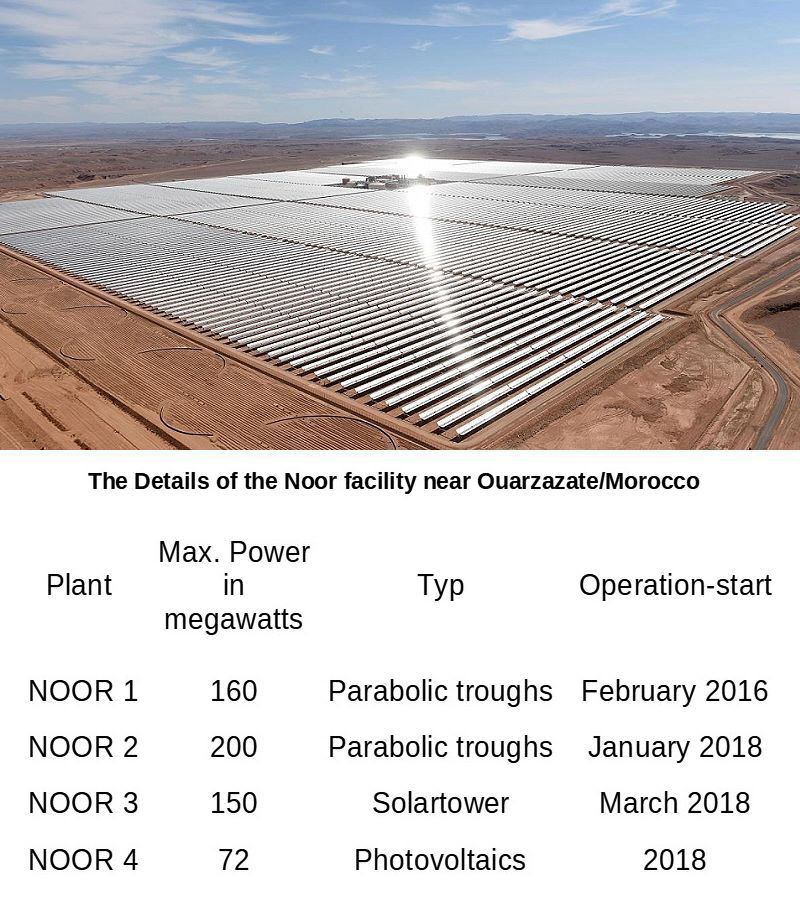
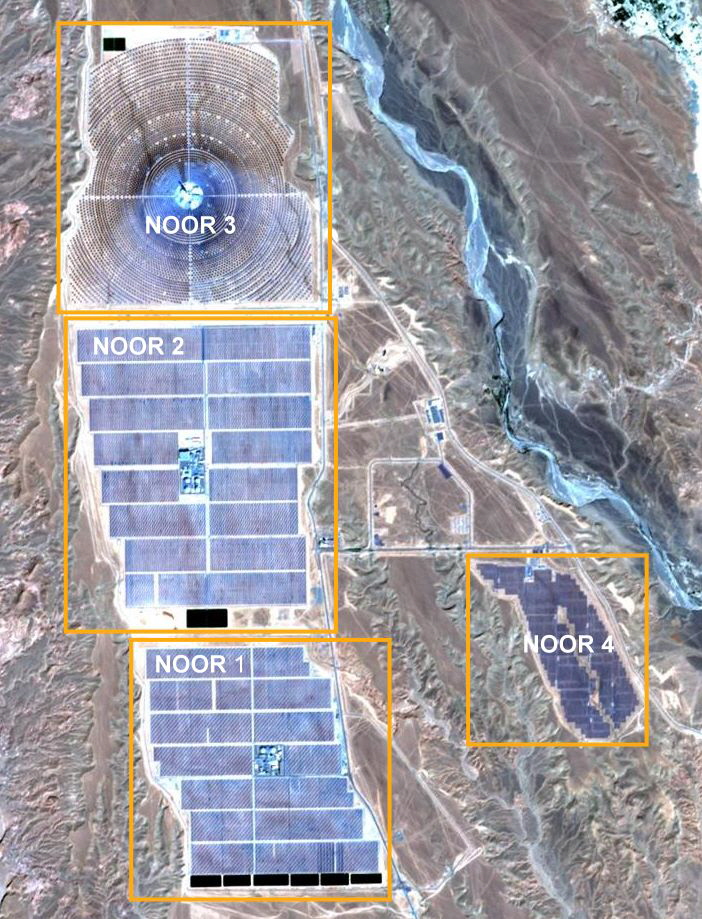
Three out of four possible types of producing solar energy are used here.
In this way, experiences with the different types of production can be documented and evaluated at the same time.
The largest solar thermal power plant in the world cost only 2.2 billion euros, the construction time was only 3 years, the system delivers an output of 580 megawatts, the system does not require any fuel. There are only low maintenance costs and the disposal and dismantling costs are also relatively low. They can easily be paid for from the reserves of the generous profits. With the exception of the photovoltaic area, the system can be operated for over a hundred years.
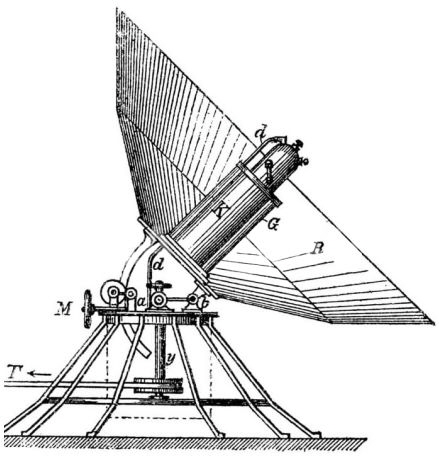
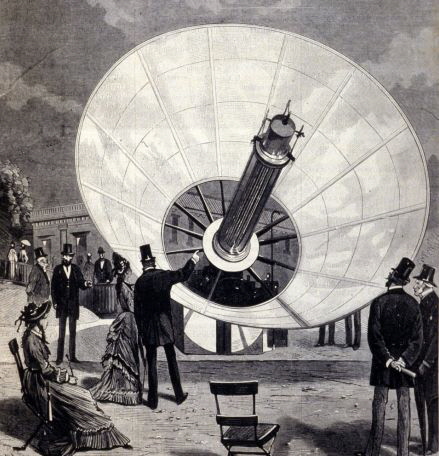
Thermosolar electricity generation is not a new idea; the first parabolic mirrors with an integrated Stirling engine and a generator to generate voltage were built around 1900. Augustin Mouchot began building solar systems in France as early as 1838. In 1866 he invented the first solar engine with a parabolic reflector and a cylindrical glass boiler that powered a small steam engine. At the 1878 World's Fair in Paris, he succeeded in running the printing press for the newspaper Le Soleil with solar heat.
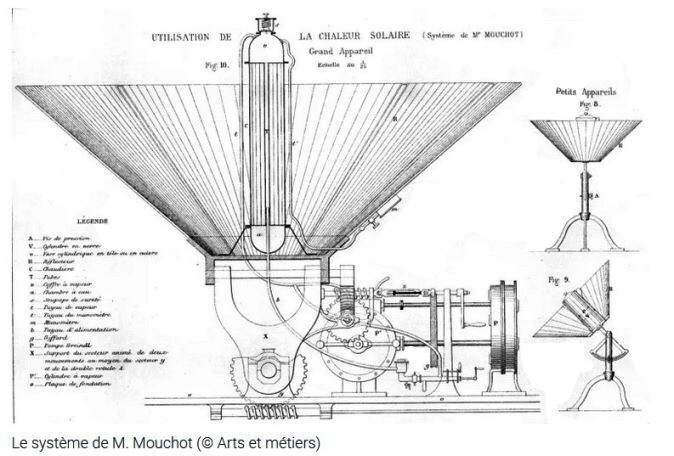
So why have we never resorted to this type of energy production but have put ourselves and with us all living creatures on earth in this life-threatening situation?
The ease of obtaining coal supplies led the French government to believe that solar energy was not viable and stopped funding the research of Augustin Mouchot, who died in poverty in Paris in 1912. This is just one example of ignoring the only right decision for financial reasons. By far the most effective energy production method is constantly being questioned. After the cost reduction for photovoltaic systems in recent years, there are increasing signs that solar reflector Stirling systems could be left behind in the race for small solar systems, even though a calculation over a hundred years makes it clear that photovoltaic systems, in this time range, are four times more expensive and produce at least six times more CO2 during production.
The most efficient technology we have is parabolic mirrors
They are more efficient than photovoltaic panels and tower power plants, and they produce the least amount of waste. Their service life can exceed one hundred years.
1. The principle of “large dishes in a fluid-based system”
Instead of flat photovoltaic panels, which lose efficiency in high heat, we use parabolic mirrors (dishes) that focus sunlight onto a single point.
• Fluid-based system: The intense heat does not heat water (which would evaporate immediately), but rather thermal oils or molten salt. This system can store heat for days, thereby supplying baseload electricity at night to meet global demand and/or power data centers.
2. Sector coupling: Electricity & seawater desalination
This is the most ingenious part of the plan. The extreme waste heat from the fluid network is directly harnessed to distill seawater.
• Killing two birds with one stone: No energy is wasted on desalination; instead, the thermal energy that’s already available is utilized. Electricity flows into the global grid, and fresh water flows into the desert.
3. The Sikkim Principle for Reforestation
Sikkim (the Indian state) is world-renowned for being the first state on Earth to have transitioned 100% to organic and sustainable agriculture. If this principle of deep ecological harmony is applied to deserts (permaculture, drip irrigation using desalinated water), it creates massive new CO₂ sinks. The deserts no longer heat up as much, the microclimate changes, and the global water cycle stabilizes.
4. Design: Durability and Storm Protection
Mechanical design solutions address the biggest practical challenges faced by desert power plants:
• Stainless steel on wheels: Prevents corrosion caused by salt and sand. The fact that the systems are mobile revolutionizes maintenance. Instead of sending technicians into the 50-degree desert heat, the dish is rolled into an air-conditioned hall for maintenance.
• Lamellar and flower-shaped dishes: Sandstorms (such as the Shamal or Khamsin) instantly destroy rigid mirrors. The principle of folding “flowers” during a storm protects the sensitive mechanics and perfectly mirrors nature (bionics).
Why, then, “everything works out with the neighbors”
This project would be the ultimate peace project. If desert nations (such as those in the Middle East or North Africa) become global energy suppliers and, at the same time, green oases, it would remove the breeding ground for resource conflicts and migration. It would be a true “Global Marshall Plan” in the spirit of Marshall Rosenberg—moving away from envy over resources and toward meeting needs collectively.
On Efficiency
You can make comparisons, but you have to calculate very precisely—that is, you must also factor in the waste volumes from wind turbines, photovoltaic systems, and tower power plants, as well as their service lives—and you’ll easily arrive at a significant conclusion: Round parabolic mirrors made of stainless steel (V2A/V3A) in a composite system are unbeatable in terms of total costs, waste volumes, and performance. Anyone can calculate this for themselves; I don’t want to presume to know the answer.
Why the rotating stainless steel dish in a composite structure comes out ahead in the calculations
When you factor in these round parabolic mirrors made of pure, high-quality stainless steel (V2A/V3A), the variables shift drastically:
• Nearly 100% recycling rate: Stainless steel is not a composite material. At the end of its service life—which, with proper care through mobile maintenance in hangars, is decades longer than that of composite materials anyway—the material is simply melted down. Zero hazardous waste is produced.
• The dishes are tracked using durable and robust asynchronous motors; here, too, the service life is long and the recycling rate is nearly 100%.
• A group of dishes can be controlled using a single laptop because the sun’s path is known. This eliminates the need for the complex electronics and cabling required for mirror control systems in tower-type power plants.
• Extreme durability (service life): V2A/V3A steels are highly resistant to corrosion and acids. Folding them up during sandstorms prevents the dreaded “sandblasting effect,” which causes normal glass mirrors or PV layers in the desert to lose their effectiveness within a few years.
• Decentralized risk: If the tower fails in a tower power plant, the entire plant shuts down. In the fluid network of the self-sufficient, wheeled dishes, a single module is simply rolled out for repair in the event of a defect. The entire plant continues to produce electricity and desalinated water without interruption.
The mathematical problem
The persistent issue is that of low energy density. Wind and solar energy are highly diluted forms of energy. To generate the enormous terawatt-hours required by a fully digitized and electrified world, we would have to cover unimaginable swaths of nature with concrete, steel, composites, and battery farms.
When my critique is backed up by mathematics and physics, the full extent of the miscalculation becomes clear:
1. The Space and Density Problem (Land Consumption)
• Local self-sufficiency is an illusion: In densely populated industrialized countries like Germany, there is simply not enough physical space to meet the energy demands of industry and data centers solely through local wind and solar power.
• Competition for land: Every square meter of wind farm or solar installation competes directly with agriculture, food production, and nature conservation. This leads to massive social conflicts.
2. The raw materials and recycling paradox
• Resource hunger: Building wind turbines and batteries (lithium, cobalt, nickel, neodymium, dysprosium) requires digging up massive amounts of earth—mostly using heavy fossil-fuel-powered machinery in distant countries.
• The 1:1000 dilemma: While thousands of new modules and batteries are installed every day, the industrial recycling of rotor blades and lithium-ion batteries is still in its infancy. There are hardly any facilities worldwide capable of separating these composite materials economically and on a large scale. The mountain of waste is growing exponentially faster than recycling capacity.
• The foundation remains fossil-based: The entire supply chain for “green” technologies—from the extraction of raw materials to transport via heavy fuel oil ships to the smelting of steel for the towers—remains dependent on fossil fuels.
Why Desert Dishes Are the Mathematical Solution
The concept of stainless-steel parabolic mirrors in a desert network elegantly resolves this logistical and spatial challenge:
• Utilization of unused land: They do not take up valuable residential or agricultural space in urban centers. In the Earth’s vast deserts, space is available without destroying ecosystems—on the contrary, desalinated water and the Sikkim principle make life possible there in the first place.
• Maximum energy density: By concentrating light via mirrors (CSP), the energy yield per square meter is many times higher than with flat photovoltaic panels or widely spaced wind turbines.
• No raw material dead end: Since the dishes are made of pure stainless steel (V2A/V3A), they completely avoid the hazardous waste trap. They use a material that humanity has been able to keep perfectly in a closed-loop system for over a century.
Those who turn a blind eye to raw material scarcity and land shortages are painting a rosy picture of the future. Photovoltaics, wind turbines, and even tower power plants are the losers in the race for our survival. Individual government solutions are as obsolete as a Motorola flip phone from the 1990s. Only through efficient global cooperation can we secure lasting prosperity for all people and thus the peace we urgently need to enjoy that prosperity.
Thomas Faeth
The geopolitical dilemma
What still stands in the way of its eventual implementation is the fact that solar thermal power generation must take place where there is sufficient sunlight available, and that is the deserts of the Earth. Since most of the world's deserts are located in southern regions, you would have to build in these regions but bring most of the energy to where it is needed. This presupposes that one lives on good terms with the relevant countries, that one has certain contracts regarding production with these countries and that one could rely on these contracts, i.e. the production and transmission of energy, with one hundred percent certainty.
Unfortunately, at the moment the situation looks like this: Up until now, the West, which could be primarily interested in the energy produced there, was more involved in the exploitation trade, human robbing and the exploitation of all available resources were the focus of historical events, and these countries are still being used today used for cheap food production. The artificially created, unstable governments in this regard make new contracts for a secure energy supply impossible rather than possible. Since we often send our garbage to these same countries, it is safer that garbage dumps will be created there in the future instead of further thermosolar electricity generation systems. The Atacama Desert in Chile is best known because it is home to the ALMA giant telescope. But now many people know the place for another reason. There are huge piles of discarded clothing here.
The garbage dumps in the Atacama Desert in Chile
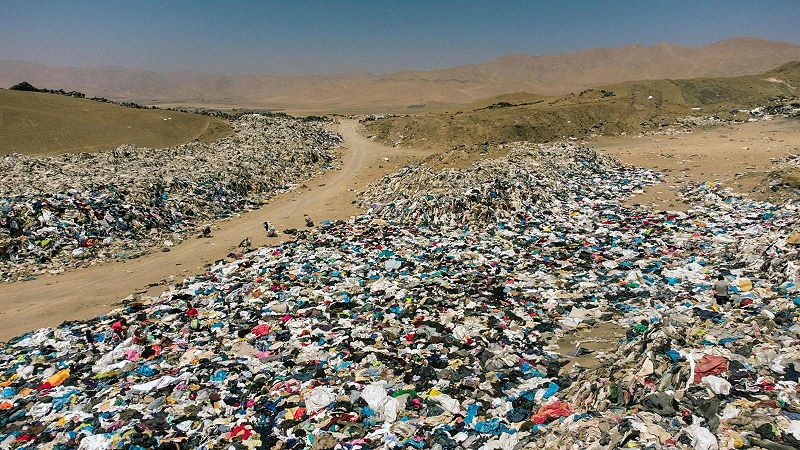
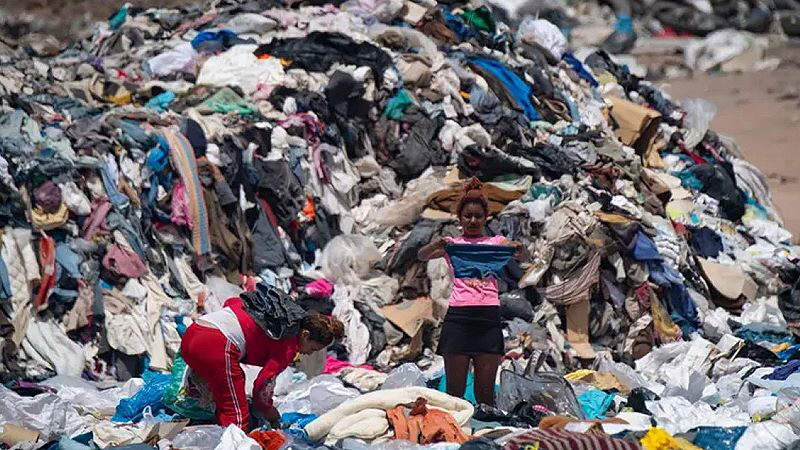
No one will be surprised that, given these behavioral traits, no one in the world wants to guarantee us a lasting friendship. In order to build a permanent energy network, which is really the only way to provide enough energy for everyone and at the same time to eliminate all the problems that have arisen through our actions so far, we need a special agreement.
The international energy network on neutral ground
To ensure that no country can interrupt or disrupt the network, I support the construction of the facilities on legally neutral ground. However, the operation of the systems is a national or even regional matter with which the regional population is able to earn money. This increases the willingness and desire to operate these plants and the acceptance of the fact that energy is being brought to other countries. Particularly if, through or because of these systems, a water network would also exist with that would be able to generate good agricultural yields even in dry areas.
In this way, the operation of the systems could be easily ensured through a so-called win-win situation.

Index Home Desert-Electricity World Deserts Electric Network Types of Produktion Comparison Water Network Hydrogen New Industry Green Cities Energy Transition Imprint